

Which Instagram automation triggers actually work, and which ones cannot
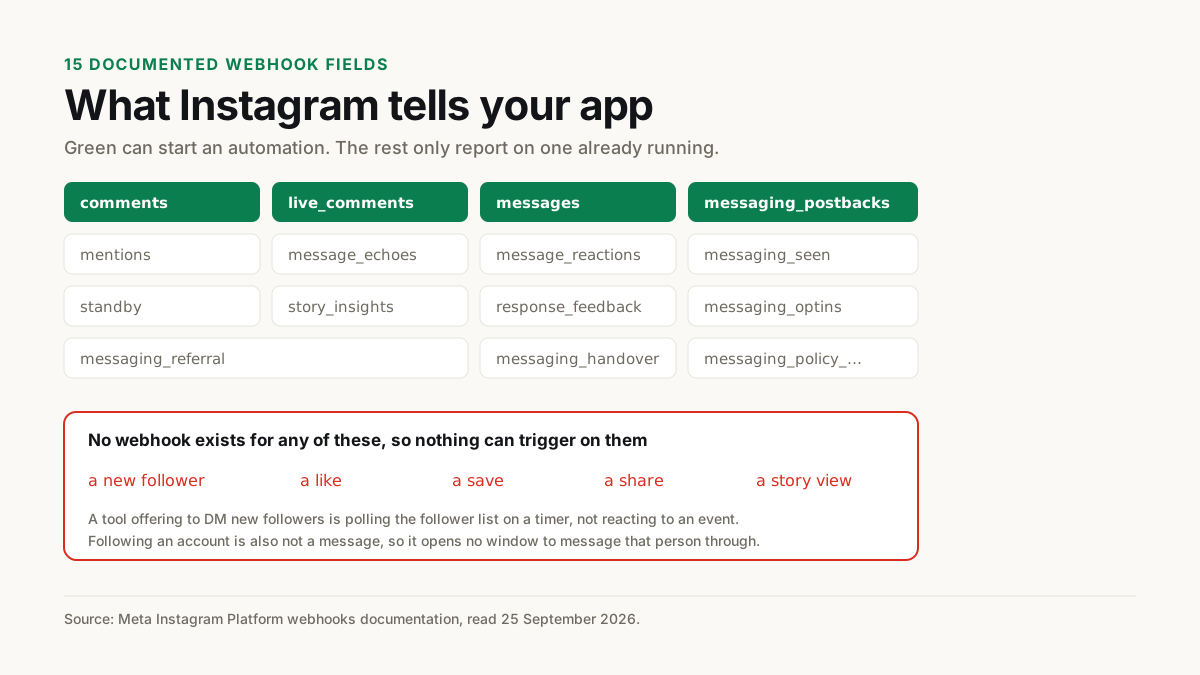
An Instagram automation can only start from something Meta tells the app about, and Meta tells apps about fifteen things. Nothing in that list is a new follower. So when a tool offers to DM everybody who follows you, it is not reacting to a follow, because there is no follow to react to.
Every reliable Instagram automation begins with a webhook. If no webhook field covers the event, no tool can trigger on it reliably, whatever the feature list says.
How a trigger actually works
When you connect an Instagram professional account to an app, the app subscribes to webhook fields. Meta then posts a small message to that app every time one of those things happens. A comment arrives, Meta posts a notification, the app decides whether it matches a campaign and sends the DM. The whole chain takes a second or two and costs nothing until something happens.
The alternative is polling, which means asking Instagram over and over whether anything changed. Polling is slower, it is limited by the same rate limits as everything else, and it can only see whatever the API will show you when you ask. For anything with a documented webhook, polling is strictly worse. For anything without one, polling is the only option there is.
The fifteen fields Meta documents
This is the complete list of Instagram webhook subscription fields. Everything an Instagram automation can react to is in here, and everything that is not in here it cannot react to.
| Field | Fires when |
|---|---|
| comments | Somebody comments on a post or reel |
| live_comments | Somebody comments during a live broadcast |
| mentions | The account is @mentioned |
| messages | A DM arrives, including story replies |
| message_echoes | A message is sent from the account itself |
| message_reactions | Somebody reacts to a message |
| messaging_seen | A message is read |
| messaging_postbacks | Somebody taps a button in a DM |
| messaging_referral | A conversation starts from a referral link or ad |
| messaging_optins | Somebody opts in to messaging |
| messaging_handover | Control of a conversation passes between apps |
| standby | Messages arrive while another app has control |
| messaging_policy_enforcement | Meta takes a messaging policy action |
| response_feedback | Feedback is given on a response |
| story_insights | Story metrics become available |
Read the list for what is missing rather than what is there. No follow. No like. No save, no share, no story view, no profile visit. Those are the events most commonly advertised as automation triggers and none of them is one.
What this means for "DM new followers"
A tool offering to message new followers has two options, and neither is a webhook.
- Poll the follower list on a schedule and compare it against last time. That means a delay of however long the gap is, it consumes rate limit whether or not anybody followed, and on a large or fast-growing account the comparison gets expensive and unreliable.
- Use something Meta has not documented for this purpose, which can stop working whenever Meta changes it, with no deprecation notice because it was never a documented feature.
There is also a more basic problem underneath the technical one. Meta's messaging rules mean an app can message somebody only after that person has messaged the account, or as the single private reply to a comment they left. Following you is neither. Somebody who followed you and never messaged you has not opened any window for you to message them through.
Following an account is not a message, so it does not open a messaging window. That is a policy limit, not a missing feature, and no tool can engineer around it.
The triggers that do work, and what each one gives you
Four of the fifteen fields carry essentially all real-world Instagram automation. Here is what each actually permits once the notification arrives.
| Trigger | What you may send | Window |
|---|---|---|
| Comment on a post or reel | One private reply to that commenter | 7 days |
| Comment on a live broadcast | One private reply to that commenter | During the broadcast only |
| A DM, including a story reply | A normal conversation | 24 hours from their last message |
| A button tap in a DM | The next step of the conversation | 24 hours, and the tap resets it |
The pattern is consistent once you see it. Instagram lets you answer people who contacted you, and the definition of contacting you is a comment or a message. Everything else somebody can do on your account is invisible to automation, deliberately.
How to test what a tool can really do
You can check a feature list against this in a few minutes, without buying anything.
- For each advertised trigger, find the matching webhook field in the table above. If there is no match, ask the vendor how it is implemented. Polling is a legitimate answer, but it should be disclosed, because it changes what you should expect.
- Ask what the delay is. A webhook trigger is seconds. A polling trigger is however long the interval is, and the vendor should be able to tell you the number.
- Ask what happens on a big day. Polling that compares follower lists behaves worst exactly when an account grows fastest.
- For anything that claims to message people who never contacted you, ask which messaging window it uses. There is no good answer to this one.
None of this makes a tool dishonest. Polling-based follower messaging genuinely works on small accounts, and plenty of people are happy with it. The problem is that it is sold beside comment-to-DM as though the two were equally solid, when one is an event Meta pushes to the app and the other is a workaround for an event Meta does not report at all.
What HookSend does with this
HookSend triggers on comments, live comments, DMs, story replies and button taps, which is to say the documented fields and nothing else. There is no follow trigger, and there will not be one until Meta documents a webhook for it.
That is a smaller feature list than some competitors advertise. It is also the reason the features that are there behave the same on an account with two hundred followers and an account with two hundred thousand.
Questions people ask about this
- Can you automatically DM new Instagram followers?
- Not through a documented trigger. Meta publishes fifteen Instagram webhook fields and none of them fires on a new follower, so a tool offering this must be polling the follower list on a schedule. Meta's messaging rules are the bigger obstacle: following an account is not a message, so it does not open a window through which the account may message that person.
- Why is my Instagram follow-to-DM automation not working?
- Most likely because it was never event driven. With no follow webhook field published by Meta, a tool offering the feature is comparing follower lists on an interval, which grows less reliable as an account gains followers faster. Check with your vendor how the trigger is implemented and what delay it runs on.
- What can trigger an Instagram automation?
- In practice four things: a comment on a post or reel, a comment during a live broadcast, an incoming DM including a story reply, and a button tap inside a DM. Meta documents eleven further webhook fields covering things like read receipts, message reactions and policy enforcement, but those report on conversations rather than starting them.
- Can Instagram automation trigger on likes, saves or story views?
- No. Meta publishes no webhook field for likes, saves, shares, story views or profile visits, so an app is never told those happened. Any automation built on them would have to poll for the information, and for most of these the API does not expose the individual person anyway.
- Is polling against Instagram's rules?
- Polling the API on a schedule is normal use of the API and is not against the rules by itself, as long as it stays within the documented rate limits and uses permissions the app was approved for. The issue is reliability rather than compliance: a polled trigger is slower than a webhook and degrades as an account grows.